
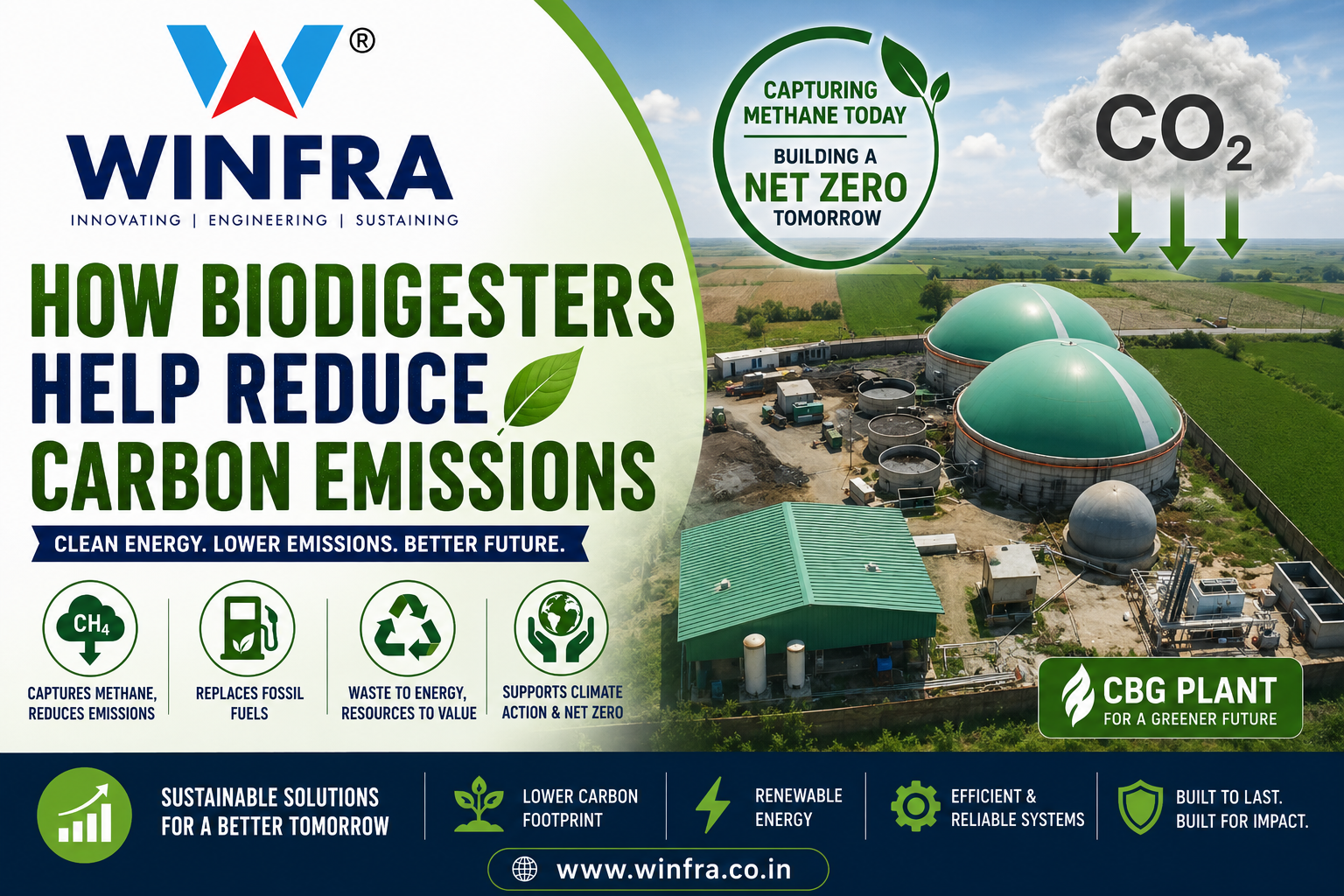
Current Market Scenario and Industry Outlook with Reference to Winfra
Biodigesters are rapidly becoming one of the most effective technologies for reducing greenhouse gas emissions while converting organic waste into renewable energy. As governments and industries push toward net-zero targets, biodigester systems are playing a critical role in waste management, renewable gas production, and carbon reduction.
What is a Biodigester?
A biodigester is an anaerobic digestion system that decomposes organic waste such as:
- Agricultural residue
- Food waste
- Animal manure
- Municipal organic waste
- Sewage sludge
The digestion process produces:
- Biogas (mainly methane and carbon dioxide)
- Organic slurry or digestate used as biofertilizer
The biogas can be upgraded into Bio-CNG or used directly for power generation and heating applications.
How Biodigesters Reduce Carbon Emissions
1. Methane Capture from Organic Waste
Organic waste dumped in landfills or open lagoons naturally releases methane, which is over 25 times more potent than CO₂ in terms of global warming potential.
Biodigesters capture this methane and convert it into usable energy instead of allowing it to escape into the atmosphere. According to recent industry studies, compressed biogas projects can reduce lifecycle greenhouse gas emissions by 70–90% compared to fossil fuels. (The Times of India)
2. Replacement of Fossil Fuels
Bio-CNG produced from biodigesters replaces:
- Diesel
- LPG
- Furnace oil
- Natural gas
This directly lowers fossil fuel consumption and carbon emissions.
A 100 TPD Bio-CNG plant can replace millions of liters of diesel annually, significantly lowering industrial carbon footprints. (The Economic Times)
3. Reduction in Agricultural Waste Burning
India faces severe pollution due to stubble burning and unmanaged agricultural waste.
Modern biodigester systems convert:
- Paddy straw
- Press mud
- Crop residue
- Cattle dung
into renewable gas and fertilizer, reducing air pollution and CO₂ emissions. Recent projects in India are expected to avoid more than 100,000 tCO₂e annually through agricultural waste-to-biogas conversion. (ESG News)
4. Circular Economy and Sustainable Waste Management
Biodigesters create a circular economy model by converting waste into:
- Renewable fuel
- Electricity
- Organic manure
This reduces landfill dependency and lowers emissions from waste transportation and disposal.
Current Global Market Scenario
The global biodigester and biogas market is witnessing strong growth due to increasing climate regulations and renewable energy adoption.
Industry reports indicate:
- Global biodigester market expected to exceed USD 80 billion by 2032
- Industrial biodigester adoption growing rapidly in Asia-Pacific
- Strong investments in Bio-CNG and RNG (Renewable Natural Gas) infrastructure (The Anaerobic Digestion & Biogas Blog)
Countries such as Germany, India, Brazil, and the United States are leading investments in biogas infrastructure.
India’s Biodigester and Bioenergy Market Outlook
India is emerging as one of the world’s fastest-growing bioenergy markets.
According to the International Energy Agency (IEA):
- India’s biofuel and compressed biogas production could double by 2030
- More than 170 CBG plants are operational
- Nearly 300 additional projects are under development (IEA)
Government initiatives such as:
- SATAT Scheme
- GOBARdhan Mission
- National Bioenergy Programme
- Carbon Credit Trading Scheme
are driving investments into biodigester infrastructure.
India’s carbon credit mechanism is also supporting small and industrial biodigester projects. In 2026, India published its first carbon credit project design document focused on installing biogas digesters in Karnataka to reduce methane emissions. (S&P Global)
Recent Industry Developments
Several major developments highlight the rapid expansion of biodigester and Bio-CNG infrastructure:
- VA Tech Wabag and Peak Sustainability Ventures announced a Bio-CNG project in Ghaziabad expected to reduce nearly 5 lakh metric tonnes of carbon emissions during its lifecycle. (The Times of India)
- Climate Fund Managers invested $32.2 million into a large-scale waste-to-biogas project in Uttar Pradesh processing 94,000 tonnes of agricultural waste annually. (ESG News)
- The Indian Biogas Association estimates India has the potential to produce nearly 60 million tonnes of compressed biogas annually. (The Times of India)
Role of Winfra in Sustainable Biodigester Infrastructure
As India’s bioenergy sector expands, companies like Winfra are contributing through advanced storage and containment solutions for:
- Biogas plants
- Biodigester reactors
- Bio-CNG facilities
- Wastewater treatment systems
- Slurry and digestate storage
Winfra’s expertise in:
- GFS Tanks
- Zincalume Tanks
- Fusion Bond Epoxy Tanks
- Modular storage systems
supports the operational efficiency and long-term durability of biodigester and renewable energy projects.
Modern modular tank technologies help improve:
- Gas-tight storage performance
- Corrosion resistance
- Faster installation
- Reduced lifecycle maintenance
- Sustainable project scalability
These solutions are increasingly important as India scales industrial biodigester and Bio-CNG infrastructure.
Future Outlook
The future of biodigesters is closely tied to:
- Carbon neutrality targets
- Renewable gas demand
- Waste-to-energy investments
- Carbon credit markets
- Industrial decarbonization
With rising environmental regulations and strong policy support, biodigesters are expected to become a major pillar of sustainable infrastructure globally.
For India, biodigesters represent not only an environmental solution but also an economic opportunity for:
- Farmers
- Municipalities
- Industries
- Renewable energy developers
The sector is expected to witness accelerated investments over the next decade, making biodigester infrastructure a key component of the green energy transition.