
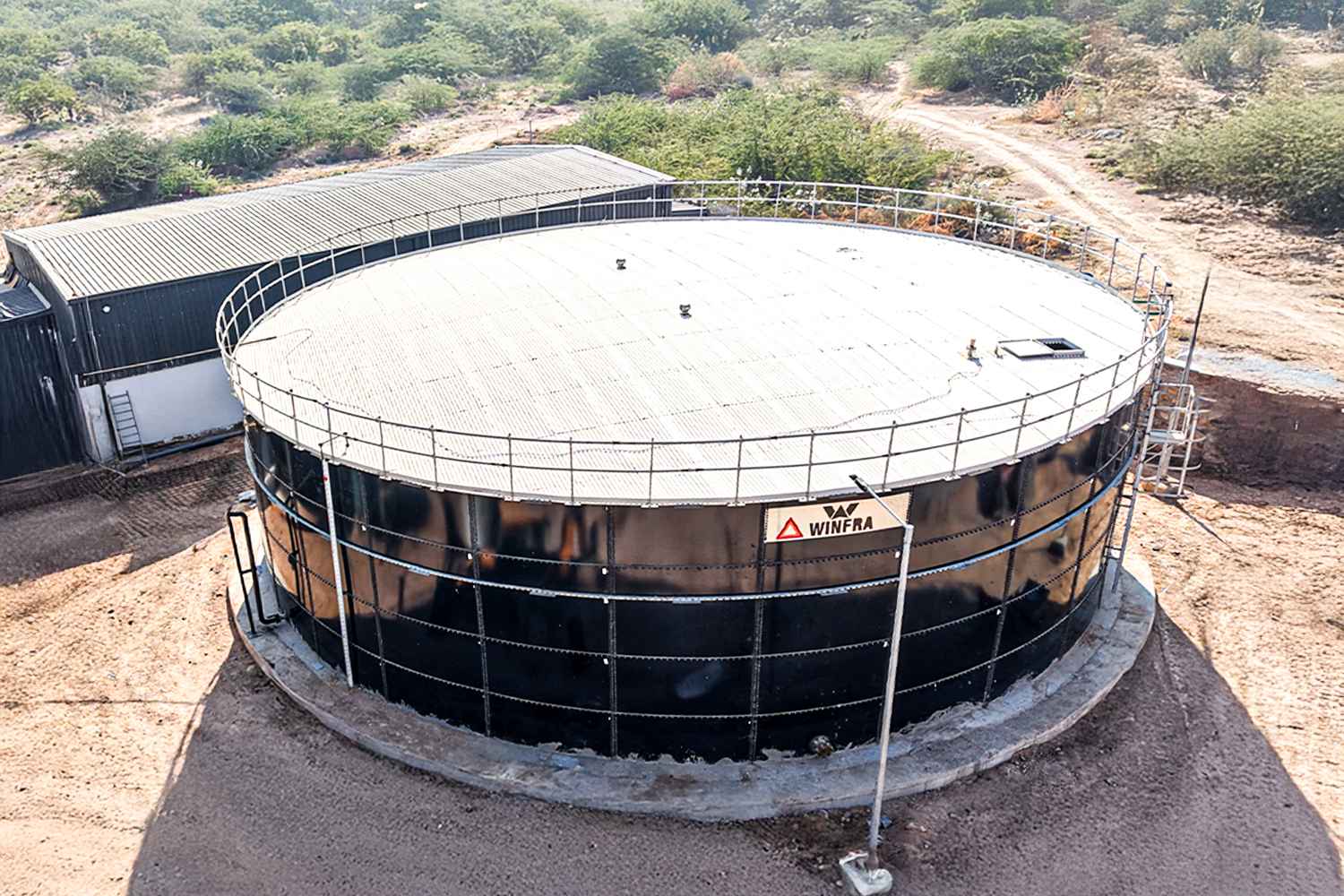
As industries and municipalities worldwide face increasing pressure to improve wastewater management, the demand for durable, corrosion-resistant, and low-maintenance storage infrastructure is rapidly growing. Traditional RCC and coated steel tanks are gradually being replaced by advanced storage technologies that offer longer service life, faster installation, and superior chemical resistance.
Among these technologies, Glass Fused Steel (GFS) tanks are emerging as the future of modern wastewater treatment plants (WWTPs) due to their advanced engineering performance and lifecycle advantages.
At Winfra, we provide internationally engineered GFS tanks designed for wastewater treatment applications, industrial effluent storage, anaerobic digestion systems, sludge storage, and process water management.
What Is a GFS Tank?
Glass Fused Steel (GFS) tanks, also known as Glass-Lined Steel tanks, are manufactured by fusing glass enamel with steel plates at extremely high temperatures of around 820°C–930°C. This process creates a chemically bonded inert layer that combines the strength of steel with the corrosion resistance of glass.
The resulting surface provides:
- High chemical resistance
- Superior anti-corrosion protection
- Smooth inert internal surface
- Long operational lifespan
- Excellent abrasion resistance
This makes GFS tanks highly suitable for aggressive wastewater environments.
Why Wastewater Treatment Plants Need Advanced Storage Solutions
Wastewater treatment plants handle highly corrosive media containing:
- Industrial chemicals
- Sulphides
- Chlorides
- Organic waste
- Biological sludge
- High-moisture content
Traditional RCC structures often face:
- Cracking and leakage
- Chemical deterioration
- Reinforcement corrosion
- Higher maintenance
- Difficult repair processes
Similarly, conventional painted steel tanks may suffer from coating failures and internal corrosion over time.
This is why modern WWTP infrastructure is increasingly shifting toward GFS tank technology.
Superior Corrosion Resistance in Wastewater Applications
One of the biggest technical advantages of Winfra GFS Tanks is their exceptional corrosion resistance.
The glass-fused coating creates a non-porous chemically inert barrier that protects the steel substrate from:
- Acidic wastewater
- Chemical exposure
- Hydrogen sulphide attack
- Moisture penetration
- Biological corrosion
This makes GFS tanks ideal for:
- Effluent Treatment Plants (ETP)
- Sewage Treatment Plants (STP)
- Anaerobic digesters
- Sludge holding tanks
- Leachate storage systems
Faster Installation Compared to RCC Tanks
In modern infrastructure projects, execution speed is critical. Winfra’s modular bolted GFS tanks significantly reduce project timelines compared to RCC structures.
Key installation advantages include:
- Factory-engineered modular panels
- Minimal on-site fabrication
- Faster erection process
- Reduced civil work dependency
- Lower labor requirements
This helps EPC contractors and wastewater project developers complete projects within tighter timelines.
Excellent Structural Flexibility and Scalability
Unlike concrete structures, GFS tanks offer modular flexibility for future expansion and process modification.
Winfra’s GFS tank systems can be:
- Expanded vertically
- Relocated if required
- Integrated with process equipment
- Customized for different capacities
This makes them highly suitable for rapidly growing industrial and municipal wastewater treatment requirements.
Long Service Life with Low Maintenance
Lifecycle cost is a major concern in wastewater infrastructure. GFS tanks provide a significantly longer operational life compared to conventional storage systems.
Technical benefits include:
- UV-resistant surface
- Minimal coating degradation
- Reduced maintenance shutdowns
- Easy inspection and cleaning
- Lower lifecycle repair costs
The smooth glass surface also minimizes sludge adhesion and bacterial accumulation inside the tank.
Ideal for Anaerobic Digestion and Biogas Applications
Modern wastewater treatment plants increasingly integrate anaerobic digestion and biogas recovery systems. GFS tanks are highly suitable for these applications because of their:
- Gas-tight sealing capability
- Chemical resistance
- Temperature stability
- Structural integrity
Winfra GFS Tanks are widely applicable in:
- CBG plants
- Biogas digesters
- Industrial wastewater plants
- Organic waste processing facilities
Compliance with International Standards
High-quality GFS tanks are designed according to internationally accepted engineering standards such as:
- AWWA D103
- ISO standards
- OSHA safety guidelines
- NFPA requirements
- International wastewater engineering practices
At Winfra, our GFS storage systems are engineered to meet demanding industrial and municipal operational requirements.
Why Winfra GFS Tanks Are Preferred for WWTP Projects
Winfra’s Glass Fused Steel tanks are designed for:
- High corrosion resistance
- Faster installation
- Long-term structural reliability
- Wastewater and sludge applications
- Low maintenance operation
- Modular expansion capability
We support EPC contractors, wastewater consultants, municipalities, and industrial clients with advanced storage solutions for modern wastewater treatment infrastructure.
With growing adoption across industrial and municipal sectors, Winfra GFS Tanks are helping shape the next generation of wastewater treatment infrastructure with reliable and internationally engineered storage solutions.