
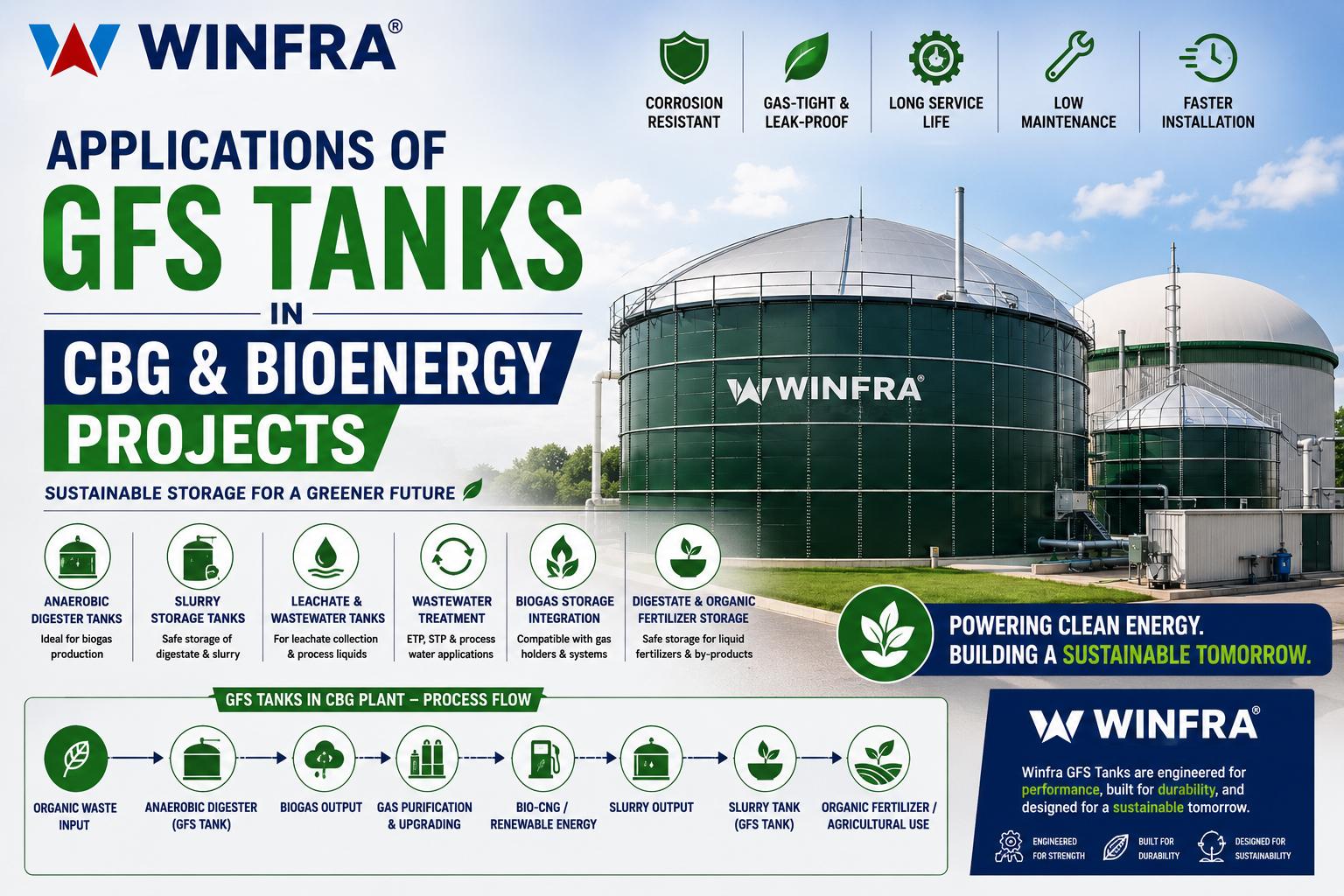
Applications of GFS Tanks in CBG and Bioenergy Projects
As the global focus on renewable energy and sustainable waste management continues to grow, Compressed Biogas (CBG) and bioenergy projects are becoming key components of the green energy transition. Industries, municipalities, and agricultural sectors are increasingly investing in biogas infrastructure to convert organic waste into clean energy and valuable by-products.
In these projects, storage infrastructure plays a critical role in ensuring process efficiency, corrosion resistance, and long-term operational reliability. This is why Glass Fused Steel (GFS) tanks are widely used in modern CBG and bioenergy plants.
At Winfra, we provide advanced GFS Tank Solutions designed for anaerobic digestion, slurry storage, wastewater management, and bioenergy applications.
What Are GFS Tanks?
Glass Fused Steel (GFS) tanks are engineered storage systems manufactured by fusing glass enamel with steel plates at extremely high temperatures. This process creates a highly durable and chemically resistant surface that combines:
- The strength of steel
- The corrosion resistance of glass
This makes GFS tanks highly suitable for aggressive environments found in:
- Biogas plants
- CBG projects
- Wastewater treatment plants
- Organic waste processing systems
Why GFS Tanks Are Preferred in CBG and Bioenergy Projects
CBG and bioenergy facilities involve highly corrosive organic media, moisture, gases, and chemical reactions. Conventional RCC or painted steel tanks often face:
- Corrosion issues
- Leakage
- Structural degradation
- High maintenance costs
Modern Winfra GFS Tanks provide:
- Superior corrosion resistance
- Gas-tight performance
- Long service life
- Faster installation
- Low maintenance operation
These advantages make them ideal for renewable energy infrastructure projects.
Major Applications of GFS Tanks in CBG and Bioenergy Projects
1. Anaerobic Digester Tanks
Anaerobic digesters are the core units of biogas and CBG plants where organic waste decomposes in oxygen-free conditions to produce methane-rich biogas.
GFS tanks are highly suitable for digesters because they offer:
- Excellent chemical resistance
- Gas-tight sealing
- Resistance to acidic and organic media
- Long-term structural durability
Winfra GFS Digester Tanks are widely applicable in:
- Cattle dung biogas plants
- Food waste biogas projects
- Press mud digestion plants
- Industrial organic waste processing
2. Slurry Storage Tanks
After digestion, biogas plants generate nutrient-rich slurry that must be stored safely before processing or agricultural use.
GFS slurry storage tanks help:
- Prevent leakage
- Reduce environmental contamination
- Improve operational safety
- Ensure long-term storage reliability
The corrosion-resistant surface of Winfra GFS tanks performs efficiently even in high-moisture organic slurry conditions.
3. Leachate Collection and Storage
In bioenergy and waste management projects, leachate generated from organic waste handling can be highly corrosive.
GFS tanks are commonly used for:
- Leachate collection
- Leachate equalization
- Wastewater storage
- Process liquid management
Their chemically inert glass coating provides long-term protection against aggressive liquids.
4. Wastewater Treatment Applications
Most CBG and bioenergy plants require integrated wastewater treatment systems for:
- Effluent treatment
- Process water recycling
- Sludge handling
- Water recovery systems
Winfra GFS Tanks are widely used in:
- Effluent Treatment Plants (ETP)
- Sewage Treatment Plants (STP)
- Anaerobic wastewater reactors
- Sludge holding tanks
5. Biogas Storage Integration
Modern GFS tank systems can also be integrated with:
- Double membrane gas holders
- Biogas balloon systems
- Gas collection roofs
This improves:
- Gas storage efficiency
- Operational safety
- Renewable energy recovery
Integrated gas-tight systems are essential for high-performance CBG plants.
6. Digestate and Organic Fertilizer Storage
Bioenergy projects often produce digestate and liquid organic fertilizer as valuable by-products.
GFS tanks provide safe and hygienic storage for:
- Liquid fertilizers
- Organic digestate
- Nutrient-rich slurry
This supports sustainable agriculture and circular economy operations.
Technical Advantages of GFS Tanks in Bioenergy Projects
Corrosion Resistance
GFS coating provides superior protection against:
- Organic acids
- Hydrogen sulphide
- Moisture
- Chemical exposure
Faster Installation
Modular bolted construction enables:
- Quick assembly
- Reduced project timelines
- Minimal site fabrication
Long Service Life
Winfra GFS tanks are designed for long operational performance with minimal maintenance.
Modular Expansion
Tank capacity can be expanded based on future project requirements.
Low Lifecycle Cost
Reduced maintenance and better durability improve long-term project economics.
Why Industries Choose Winfra GFS Tanks
At Winfra, we manufacture advanced GFS storage systems designed for:
- CBG projects
- Biogas plants
- Wastewater treatment systems
- Slurry storage
- Organic waste management
Our GFS tanks offer:
- High corrosion resistance
- Gas-tight sealing performance
- Faster installation
- Low maintenance operation
- Long-term structural reliability
We support EPC contractors, renewable energy developers, municipalities, and industrial clients with internationally engineered storage infrastructure solutions.