
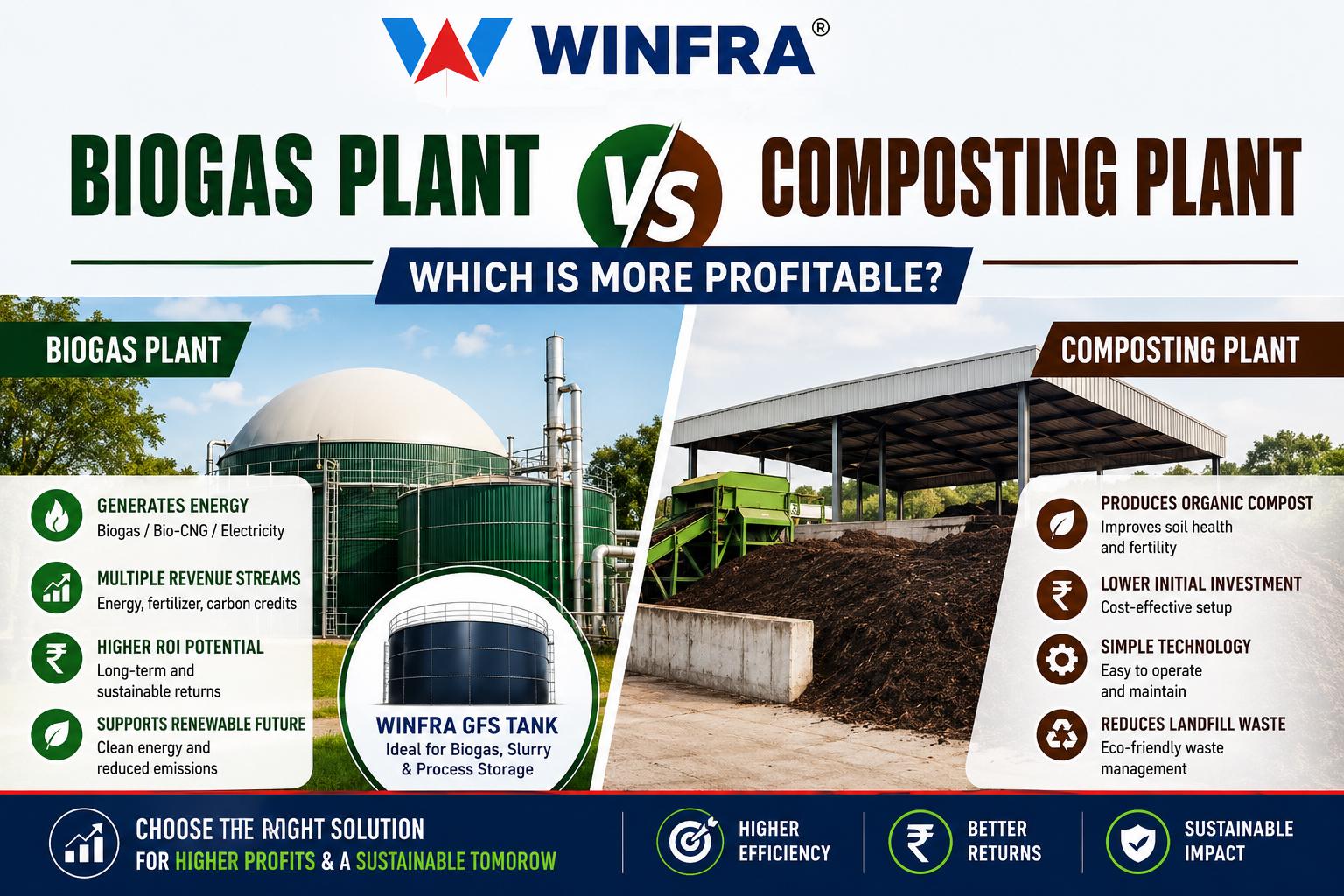
Biogas Plant vs Composting Plant: Which Is More Profitable for Modern Waste Management?
As industries and municipalities focus more on sustainable waste management and renewable energy, the demand for efficient organic waste processing solutions is growing rapidly. Today, two of the most widely adopted systems are biogas plants and composting plants.
Both technologies help convert organic waste into valuable resources, but when it comes to profitability, operational efficiency, and long-term returns, many businesses struggle to decide which option is better.
If you are planning to invest in organic waste management infrastructure, understanding the difference between a biogas plant and a composting plant is essential.
At Winfra, we support modern biogas and waste management projects with advanced GFS Tank Solutions designed for anaerobic digesters, slurry storage, wastewater storage, and bioenergy infrastructure.
What Is a Biogas Plant?
A biogas plant is a system that converts organic waste into biogas through an anaerobic digestion process. In simple terms, microorganisms break down organic waste in an oxygen-free environment to produce methane-rich gas.
The generated biogas can be used for:
- Electricity generation
- Bio-CNG production
- Industrial fuel applications
- Cooking gas applications
Biogas plants can process:
- Food waste
- Cow dung
- Agricultural residue
- Press mud
- Organic industrial waste
Modern biogas projects also generate organic slurry that can be used as fertilizer.
Today, many industrial biogas projects use Winfra GFS Tanks because of their corrosion resistance, gas-tight performance, and long operational life in anaerobic digestion applications.
What Is a Composting Plant?
A composting plant converts organic waste into compost fertilizer through aerobic decomposition, where waste breaks down in the presence of oxygen.
Composting is commonly used for:
- Municipal organic waste
- Garden waste
- Agricultural residue
- Food waste
- Organic sludge
The final product is organic compost that improves soil fertility and supports sustainable farming practices.
Compared to biogas systems, composting plants are generally simpler and require lower investment.
Biogas Plant vs Composting Plant: Profitability Comparison
1. Revenue Generation
Biogas Plant
Biogas plants generate multiple income sources, including:
- Bio-CNG sales
- Electricity generation
- Carbon credits
- Organic fertilizer sales
- Industrial gas supply
With increasing demand for renewable energy, biogas projects are becoming highly profitable.
Composting Plant
Composting plants mainly generate revenue through:
- Compost fertilizer sales
- Waste processing fees
The revenue potential is comparatively lower than biogas projects.
More Profitable Option:
✔ Biogas Plant
2. Initial Investment
Biogas Plant
Biogas projects require:
- Anaerobic digesters
- Gas storage systems
- Gas purification units
- Slurry handling systems
- Advanced process infrastructure
This increases the initial capital investment.
Composting Plant
Composting plants require simpler infrastructure such as:
- Compost yards
- Aeration systems
- Waste segregation equipment
The setup cost is much lower.
Lower Investment Option:
✔ Composting Plant
3. Operational Complexity
Biogas Plant
Biogas plants require technical monitoring for:
- Gas pressure
- Digester temperature
- Slurry circulation
- Biological activity
Professional operation and maintenance are important for stable performance.
Composting Plant
Composting systems are comparatively easy to operate and manage.
Easier to Operate:
✔ Composting Plant
4. Long-Term Return on Investment
Biogas Plant
Although investment is higher, biogas plants often deliver better long-term ROI because they generate renewable energy and multiple revenue streams.
Government incentives for CBG and renewable energy projects further improve profitability.
Composting Plant
Composting provides steady but comparatively lower financial returns.
Better Long-Term ROI:
✔ Biogas Plant
Why GFS Tanks Are Important in Modern Biogas Plants
One of the most critical components of a biogas project is the storage and digestion infrastructure. Since anaerobic digestion involves highly corrosive organic media, storage tanks must provide:
- Corrosion resistance
- Gas-tight sealing
- Long service life
- Low maintenance performance
This is why many developers prefer Winfra GFS Tanks for:
- Anaerobic digesters
- Slurry storage tanks
- Leachate storage
- Process water tanks
- Wastewater treatment systems
Winfra’s Glass Fused Steel tanks combine the strength of steel with the corrosion resistance of glass, making them ideal for demanding biogas and wastewater applications.
Which Solution Is Better for Your Business?
Choose a Biogas Plant If:
- You want long-term profitability
- Renewable energy generation is a priority
- Organic waste availability is high
- You want multiple revenue streams
- You are planning a CBG project
Choose a Composting Plant If:
- Investment budget is limited
- Simpler operation is preferred
- Small-scale waste management is required
- Fertilizer production is the primary objective
Why Industries Choose Winfra for Biogas Infrastructure
At Winfra, we provide advanced storage infrastructure solutions for:
- Biogas plants
- CBG plants
- Wastewater treatment systems
- Anaerobic digestion projects
- Industrial process storage
Our Winfra GFS Tanks are engineered for:
- High corrosion resistance
- Faster installation
- Long operational life
- Low maintenance
- Reliable gas-tight performance
We support industries with modern storage technologies designed for sustainable infrastructure and renewable energy projects.
Final Conclusion
Both biogas plants and composting plants play important roles in sustainable waste management. However, when profitability, energy generation, and long-term returns are considered, biogas plants offer significantly higher growth potential.
Composting remains an effective low-investment solution for organic fertilizer production, while biogas plants provide:
- Renewable energy generation
- Multiple revenue streams
- Better long-term ROI
- Sustainable waste utilization
With advanced infrastructure solutions like Winfra GFS Tanks, modern biogas plants can achieve better efficiency, reliability, and long-term operational performance.